
Dometrain vs Pluralsight: Which Platform Is Actually Better for Software Engineers?
Compare Dometrain vs Pluralsight on quality, updates, pricing, support, and real-world learning for engineers.


© 2026 Dometrain. All rights reserved.
Let’s be honest. When most developers compare learning platforms, they’re not asking: “Which platform aligns with my long-term growth strategy?”
They’re asking:
We’ve all been there. We’ve all got a “Udemy graveyard” of $10 courses we bought during a 2 a.m. burst of motivation, only for them to sit at 4% completion forever. On paper, Dometrain and Udemy both teach, but in reality, they’re built on completely different philosophies.
One is curated, focused, and engineering-first. The other is a massive global marketplace where literally anyone with a webcam can upload a course.
Full disclosure: this comparison is written by Dometrain, but everything below is based on publicly available information and user feedback.
At-a-Glance Comparison
| Feature | Dometrain | Udemy |
|---|---|---|
| Trustpilot Rating | ⭐ 4.7 / 5 | ⭐ 1.8 / 5 💩 |
| Number of Courses | 100+ highly curated | 200,000+ marketplace courses |
| Quality Control | Strictly controlled | Open marketplace (anyone can publish) |
| Course Updates | Frequently updated | Varies; update status loosely enforced |
| Learning Structure | Clear, intentional learning paths | “Pick and pray” |
| Hands-on Projects | Strong, real-world focus | Highly variable |
| Support Experience | Direct support, when you need it | Chatbots |
| Pricing | £33.33/month when billed annually | $10–$199 per course, $12/month subscription (limited) |
| Certificates | Included | Included per course |
Now let’s get into it, because surface-level comparisons are crap without context.
Trustpilot ratings:
That’s not a rounding error. That’s a canyon.
When over 50% of reviews are 1-star (as is currently the case for Udemy), that tells you something systemic is going on.
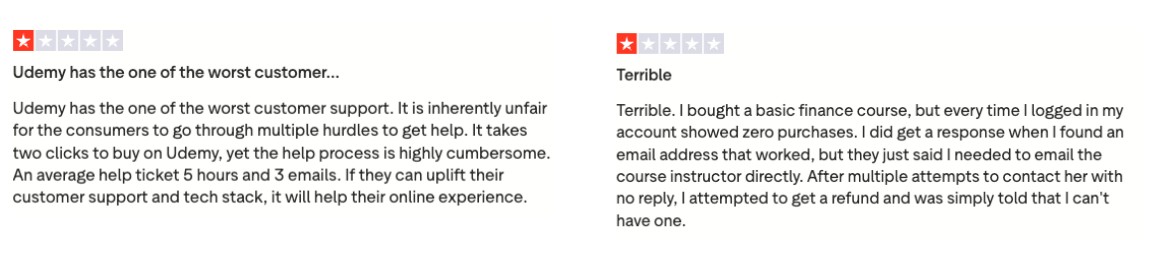
Common complaints include:
Now, to be fair, Udemy operates at an enormous scale. With millions of users, complaints scale too. But here’s the uncomfortable truth: if your business depends on volume, quality control gets harder, support gets harder, and consistency gets harder too.
Dometrain is smaller and focused specifically on software engineering, and that focus shows up in customer satisfaction.
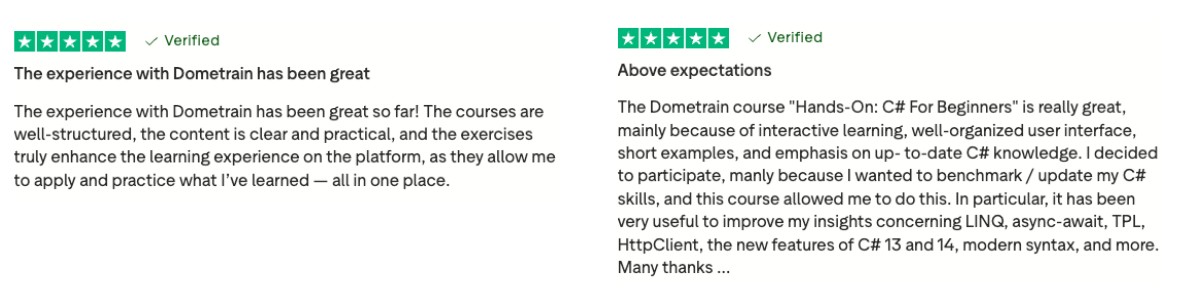
Here’s how reviewers overwhelmingly describe Dometrain:
One recurring theme in Dometrain reviews is empowerment. When people finish a course, they walk away feeling more capable in their day job; they don’t just have a PDF certificate to hide on LinkedIn.
Another big one? The platform itself. Users frequently mention that the interface feels clean and purposeful, and that hands-on learning starts early rather than being buried in theory.
This isn’t about big = bad, it’s about incentives. Marketplace platforms optimize for growth, while curated platforms optimize for experience. And those two things do not produce the same outcomes.
Udemy has over 200,000 courses. If you search for C# and .NET Programming courses, you’re met with a staggering 417 pages of results, and virtually all of them claim to be a masterclass.
The reality? Some are excellent, some are mediocre, and others are completely outdated and clearly rushed. Because Udemy is a marketplace, anyone can publish, and there’s no meaningful gatekeeping.
You get:
But you also get:
Dometrain has 100+ courses. That’s intentional. It’s not trying to be the Amazon of education; it’s trying to be focused. You don’t scroll through 50 versions of the same topic; you follow curated paths built by practitioners who actually work in the field.
If you like freedom and chaos, Udemy gives you that. If you like signal over noise, Dometrain leans that way.
Tech moves fast. A .NET course from 2020 can age badly, and a cloud course from 2021 can already be behind. Update frequency matters.
This is where marketplace dynamics get interesting.
Udemy does not tightly enforce content freshness. Instructors can trigger “updated” status through minor edits, and there’s no centralized academic oversight. Some instructors are fantastic and constantly update their content, while others launch a course, cash in during promotional waves, and move on.
Add another factor: Udemy is a public company and has increasingly prioritized enterprise revenue. Over time, instructor revenue percentages have shifted, and many publicly state that they earn less per sale than they used to. And with lower financial incentive comes less motivation to update and engage.
If you’re buying a single course at a discount, maybe it’s fine. But if you’re building a career foundation? You probably want stronger guarantees.
Courses are regularly maintained by authors who are deeply involved in the ecosystem, and updates aren’t just cosmetic.
When frameworks evolve, courses evolve. Just the way it should be.
Learning software engineering isn’t about hoarding random skills; it’s about sequencing knowledge properly. You don’t jump from “Hello World” to distributed systems architecture overnight.
Udemy recently introduced “Career Accelerators.” That’s a step toward structure.
But here’s the reality:
Most Udemy learners still operate in “course shopping” mode. You buy one thing. Then another. Then another. Sometimes it works. Sometimes you end up with 27 unfinished courses and no coherent progression.
We’ve all been there.
Dometrain builds curated learning paths.
That means:
This reduces cognitive overhead because you don’t have to ask: “Is this the right next step?” You just follow the path.

This is where the gap widens. A lot of online learning is passive; you watch, you nod, you move on. You feel productive, but you aren’t.
Availability of hands-on learning depends entirely on the instructor. Some courses are project-heavy and excellent.
Others are:
Because there’s no enforced curriculum standard, depth is inconsistent. You can find gold on Udemy, but you have to mine for it.
Dometrain removes that step.
Dometrain courses have heavy emphasis on:
You don’t just learn syntax, you learn how things fit together.
This matters more than people think. At scale, support becomes automation-heavy.
Udemy reviews frequently mention:
That’s what happens when you serve millions globally at marketplace margins.
Dometrain, being smaller and focused, can offer more direct support and stronger instructor engagement.
It’s not magic. It’s math. Smaller ecosystem = easier human interaction.
Udemy’s pricing model is aggressive.
You’ll see:
And yes, you can grab great deals. If you need one course on a specific topic, Udemy can be extremely cost-effective.
They also offer a $12/month subscription, but:
Dometrain costs:
Different philosophy.
Udemy = transactional purchases. Dometrain = continuous skill development.
If you treat learning like Netflix, a subscription makes sense. If you treat learning like “I just need one .NET crash course,” Udemy wins on short-term price. But cheap + unfocused + inconsistent can become expensive in wasted time, and time is the real currency.
When you’re choosing a training platform for an engineering team, the stakes are higher. This isn’t about grabbing a $12 course on sale.
It’s about:
At that point, the difference between a broad marketplace and a focused engineering platform becomes very clear.
Let’s break it down.
Udemy’s enterprise offering is built for scale.
It provides access to a large cross-disciplinary library, tech, marketing, design, leadership, compliance, and more, all in one place. For companies that want a single platform covering multiple departments, that breadth can be attractive.
However, it still operates on a marketplace foundation.
That means:
For general upskilling or light exposure to topics, this may be sufficient.
But if your goal is deep technical capability, modern architecture, distributed systems, performance, and advanced .NET, you’re relying on individual instructor quality rather than platform-level standards.
It’s flexible. It’s broad. But it’s not engineered specifically for software teams.
Dometrain is built specifically for software engineers.
Its business offering centers on:
This isn’t slide-based learning. Engineers build, code, and implement.
For businesses, that translates into:
On the management side, Dometrain includes an admin portal for tracking learner progress and engagement, along with tools to help measure ROI, making internal reporting far easier.
It’s also already used by 1,000+ companies and over 62,000 students, with strong feedback highlighting depth, clarity, and real-world applicability.
If Udemy is breadth-first, Dometrain is depth-first. And for engineering teams, depth is usually where the real return lives.

In December 2025, Coursera acquired Udemy. So, what does that mean?
Possibilities:
It could improve things. It could complicate things.
But as of right now, Udemy still functions as a large-scale marketplace with all the pros and cons that come with that.
Let’s put it simply.
Marketplace platforms optimize for scale; curated platforms optimize for depth. Those aren’t the same thing.
200,000+ courses sound impressive, but more isn’t automatically better. If anything, the explosion of online courses has made one thing painfully clear: choice without curation becomes noise, and noise wastes time.
If your goal is casual learning or grabbing a quick skill at a discount, Udemy can absolutely serve you.
If your goal is structured, serious growth as a developer, especially in .NET and backend engineering, a focused platform built specifically for that purpose may offer a stronger return.
